

Article: Singapore Skyline Wall Art: How to Bring the City’s Iconic Landmarks Into Your Home
Singapore Skyline Wall Art: How to Bring the City’s Iconic Landmarks Into Your Home
Some places stay with us through their buildings. A particular skyline can bring back the feeling of arriving in a city for the first time, walking beside the water at dusk or looking down over familiar streets from a height. Singapore has a particularly recognisable cityscape, where modern towers, waterfront attractions and carefully designed public spaces create a visual identity that is both contemporary and distinctly local.
That is part of the appeal of Singapore artwork based on the city’s landmarks. It can be decorative, but it can also hold a memory. For someone who lives in Singapore, it may represent a familiar part of daily life. For someone who has visited, it may recall a trip that still feels important. And for someone decorating a home overseas, it can provide a connection to a city they miss.
Why Singapore’s landmarks work so well as wall art
A successful city print needs more than a famous building. It needs a composition that works visually at a distance and continues to hold interest when viewed more closely. Singapore offers a variety of architectural subjects: the distinctive form of the Singapore Flyer, the towers around Marina Bay, the waterfront setting and the contrast between contemporary structures and older buildings.
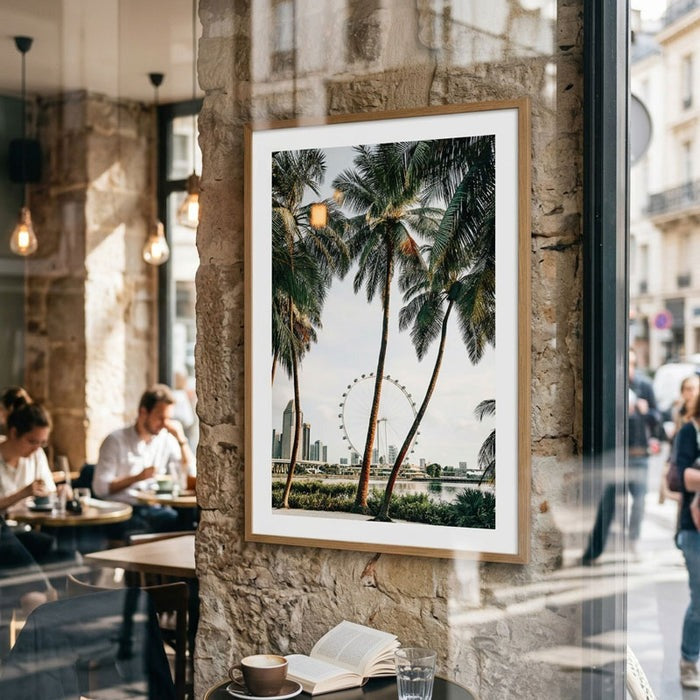
The Singapore Flyer, officially launched in 2008, stands 165 metres tall and has a diameter of 150 metres. Its design was conceived by architect Kisho Kurokawa and DP Architects, with the intention of complementing the city skyline.
These details help explain why the Flyer is such a recognisable subject: its circular structure creates a strong silhouette, while its position gives it a relationship with the surrounding city.
A print featuring the Flyer can work particularly well in a modern living room, study or office. Its geometry provides a clear focal point, especially when the rest of the room has simple furniture and restrained colours. Singapore Flyer art print is an example of a landmark-led piece that can give a room a more specific sense of place.
The appeal of Marina Bay’s architecture
Marina Bay is one of the most recognisable parts of Singapore’s contemporary image. It brings together large-scale architecture, public spaces and views across the water. The area is not visually interesting only because of individual buildings; it is the way those structures sit together that gives the skyline its character.
This makes Marina Bay-inspired Singapore poster designs particularly versatile. A composition focused on the towers can feel architectural and structured. A wider scene can introduce the waterfront and open space. A print that includes more than one landmark can suggest the experience of seeing the city as a whole rather than focusing on a single attraction.
When choosing a print, consider the room’s existing lines. If your interior has tall shelving, vertical windows or a high ceiling, a composition with strong vertical elements may feel natural. If the artwork is going above a sofa or a long console, a wider image may sit more comfortably. The purpose is not to match every line in the room, but to make the artwork feel as though it belongs there.
The Singapore collection offers a way to compare landmark subjects with botanical and other city-inspired imagery. That comparison is useful because a room does not always need the most recognisable landmark. Sometimes a quieter image creates a better atmosphere.
Pair architectural prints with the right interior style
Landmark artwork can look excellent in a contemporary home, but it does not have to be restricted to minimalist interiors. In a modern space, a Singapore city print can reinforce clean lines, glass, metal and neutral colours. In a warmer interior, it can provide contrast against timber, textured fabrics and softer lighting.
The trick is to avoid turning the room into a collection of unrelated travel souvenirs. Choose one main architectural image and let it lead the arrangement. If you want to add a second print, make sure the images share a visual quality: similar tones, related subjects or a consistent photographic style. Two prints do not need to show the same landmark, but they should feel as though they belong together.
For example, The Towers by the Bay Singapore art print can serve as the architectural anchor in a living room or study. Its subject lends itself to a more structured arrangement, particularly when displayed above a console or in a space with simple furniture. Keep nearby accessories relatively restrained so the print has room to breathe.
Choosing a city print that has personal meaning
Searches for art prints Singapore can come from different motivations. Some buyers are furnishing a new apartment; others are looking for a gift, remembering a holiday or choosing artwork for an office. The best choice depends on the connection the buyer wants to express.
If the print is for your own home, think about the parts of Singapore that matter to you. Perhaps Marina Bay is where you take visitors, where you go for evening walks or where you first experienced the city. A familiar landmark can make a room feel more personal because it connects the space to an actual memory.
If the print is a gift, consider the recipient’s relationship with the city. Someone who has lived in Singapore for years may appreciate a familiar architectural view more than a generic travel image. Someone who has only visited briefly may prefer a landmark that immediately brings back the excitement of the trip. The image becomes more meaningful when it reflects the person rather than simply the destination.
Get the scale and lighting right
A landmark print needs enough space to be appreciated. If it is too small for the wall, the details may be difficult to notice and the composition can feel disconnected from the furniture. Above a sofa or long sideboard, consider a larger landscape format or a carefully arranged pair. In a narrower hallway, a single vertical or compact print may work better.
Lighting can change how an architectural print looks. Avoid placing framed artwork where strong direct sunlight falls on it for long periods, and consider reflections if you are using glazing. Singapore’s humidity also makes appropriate framing and placement important. Local art-care guidance recommends avoiding damp locations, unstable environmental conditions and excessive light exposure.
A well-positioned print should be visible without creating glare or competing with television screens and windows. Take time to test the position before hanging it permanently.
Let the city become part of the room
A city print is at its best when it does more than fill an empty wall. It gives the room a point of reference: a place, a memory or an architectural detail that means something to the person who lives there. Singapore’s skyline offers plenty of visual variety, from the sweeping circle of the Flyer to the striking towers beside the bay.
If you are choosing wall art Singapore buyers can enjoy beyond a passing trend, look for a composition that works with your space and reflects the way you see the city. Explore the Singapore wall art collection and choose a landmark that brings a little of Singapore’s character into your everyday surroundings.


Leave a comment
This site is protected by hCaptcha and the hCaptcha Privacy Policy and Terms of Service apply.