



Article: Why Black and White Beach Photography Never Loses Its Sense of Place

Why Black and White Beach Photography Never Loses Its Sense of Place
A Beach Is Never Just a Beach
Ask someone to describe their favourite beach and they will rarely begin with its colour palette. They might remember the difficult walk down to the sand, the shape of the headland, the sound of waves breaking against a particular stretch of rock, or the feeling of arriving early enough to find the shoreline almost empty. Even two beaches with similar water, sand and sky can leave entirely different impressions. One may be associated with childhood holidays, another with a journey taken alone, and another with a place someone visits every morning before work. The physical landscape matters, but the experiences attached to it are what make that landscape personal.
Photography has a remarkable ability to preserve part of this relationship. A photograph cannot reproduce the salt in the air, the temperature of the water or the scale of a coastline experienced in person. What it can preserve is a particular arrangement of details: a familiar jetty, the outline of a headland, a surfer moving across the shoreline or the precise way afternoon light falls across the ocean. These details distinguish one place from another, even when the subject appears universal.
This is the difference between a picture that merely depicts the beach and one that communicates a sense of place. The first offers a recognisable subject; the second suggests that the landscape has its own identity. That distinction helps explain the lasting appeal of black and white beach photography. When a photograph depends less on the instantly recognisable colours of the seaside, its character often emerges through composition, light, texture and the particular details that make the location memorable.
The Australian Coast Has Always Carried a Story
In Australia, the beach occupies a place in the national imagination that extends far beyond recreation. Coastal settlements, swimming culture, surf communities, tourism and everyday life have all contributed to the ways Australians represent their relationship with the sea. Beaches are simultaneously public spaces, personal retreats and recognisable parts of regional identity. Their meaning comes not only from their natural beauty but also from the lives repeatedly lived around them.
The National Gallery of Australia's historical exhibition, Ocean to Outback: Australian Landscape Paintings 1850–1950, explores the importance of landscape in Australian art and the changing ways artists represented the country. Its accompanying historical material notes that, by the mid-1880s, beach leisure and sun worship had become increasingly significant subjects in Australian art and culture. The coastline was becoming more than a geographical boundary; it was part of how Australians pictured their own country.
Photography extended this relationship into a different medium. A painter might interpret the coast through colour, brushwork and selective detail, while a photographer could record the arrangement of a particular moment with extraordinary precision. Yet a photograph is never simply a neutral record. The photographer decides where to stand, what to include, when to expose the image and how the final print should appear. Those decisions influence whether a beach feels crowded or solitary, dramatic or restrained, familiar or unfamiliar.
The National Gallery of Australia's discussion of Australian photography from 1972 to 1982 offers a useful perspective on this idea. In discussing Wesley Stacey's panoramic landscapes, the gallery distinguishes between black-and-white images that evoke a more abstract, symbolic sense of place and colour photographs that can be more descriptive. Although the discussion concerns landscape photography more broadly, it helps explain why monochrome images can communicate something beyond the appearance of a location. They can encourage us to consider the landscape as a relationship between shapes, distances, textures and atmosphere.
What Black and White Reveals About a Particular Coastline
Colour can identify a scene immediately. A bright blue sea, golden sand and green headland may communicate the idea of an Australian summer before the viewer has noticed anything else. Black and white photography removes those familiar cues and asks the composition to do more of the work. The photograph must establish its identity through the arrangement of light and dark, the character of the landscape and the details that distinguish the location.
Consider the difference between two coastal photographs. One might show a broad, uninterrupted horizon with almost no visible human activity. Another might include a rocky foreground, a narrow strip of sand and a distant surfer. Both depict the coast, but they communicate different experiences. The first may suggest distance and stillness; the second may feel more immediate because the figure gives the landscape a human scale. Neither effect comes exclusively from the subject. It develops through the way the photograph organises the relationship between the subject and its surroundings.
This is one reason monochrome coastal photography can reward repeated viewing. The first impression may come from the overall scene, but later attention shifts towards smaller details: the texture of wet sand, the shape of a breaking wave, the shadow beneath a rock or the gap between a person and the horizon. Without a strong colour contrast dominating the image, these details can become part of its lasting character.
The National Gallery of Australia has also documented the tradition of black-and-white imagery in Recent Australian Photography, including photographs of Sydney beaches. This history reinforces an important point: monochrome is not simply a fashionable treatment applied to a coastal scene. It has been used by photographers as a deliberate visual language, capable of making ordinary places feel intimate, graphic, contemplative or emotionally charged.
Why a Photograph of a Real Place Can Feel More Personal
Travel changes our relationship with places because we experience them through specific circumstances. A beach visited during a family holiday may remain associated with a particular period of life. A coastline discovered during a long drive may represent freedom or the pleasure of being somewhere unfamiliar. Even a place visited only once can become memorable because of what was happening when we encountered it.
A photograph of that location can become a point of return. It does not need to reproduce the entire experience; a single recognisable feature may be enough to bring the place back into memory. A particular headland, the architecture of a pier or the familiar outline of a beach can carry more personal meaning than a technically impressive photograph of an anonymous coastline.
This relationship between photographs and memory has also been examined in academic work. In the article Photo-Text Topographics: Memory and Place in Sally Mann's Hold Still, published by Journal of American Studies, Christopher Lloyd examines how photographs, writing and landscape interact in the construction of personal and regional memory. The research concerns a specific artist and historical context, rather than coastal wall art directly, but it provides a useful broader insight: photographs do not simply preserve a view. Their meaning can develop through the memories, narratives and associations that viewers bring to them.
For artwork displayed at home, this is a meaningful distinction. A generic beach image may fit a colour scheme, but a photograph of a place someone knows can contribute another layer to the room. It may recall a journey, represent a connection to a particular coastline or express a desire to return. The photograph becomes part of the home's personal history rather than merely an accessory chosen to complete a decorating scheme.
From Bondi to Byron Bay: The Importance of Specificity
Australian coastal photography offers an especially rich range of subjects because different beaches possess different visual characters. Bondi is associated with a distinctive urban beach culture; Byron Bay's coastline includes rocky headlands, surf breaks and stretches of open shoreline; and Newport Beach in California has its own relationship between the Pacific, beach communities and the built environment. These places may share the ocean, but they do not share an identical atmosphere.
That specificity is important when choosing a photograph. A strong coastal image does not have to feature a famous landmark, but it should offer something that distinguishes it from countless other pictures of the sea. It might be the way a surfer moves through the frame, the contrast between a rocky headland and open water, or the presence of coastal architecture that places the viewer in a recognisable environment.
The Black and White Newport Jetty Arty from Oblong Shop illustrates this approach. Photographed by Seus Ku, it captures a lone surfer crossing the rocky shoreline at Wategos in Byron Bay. The figure gives the composition a human point of reference, while the surrounding rock and water establish the character of the place. The photograph is not simply an image of a surfer or a beach; it records the relationship between a person and a particular coastal landscape.
A different image can communicate place through architecture or the arrangement of the shoreline. The Black and White Byron Bay, for example, offers a quieter interpretation of the California coast through natural light and subtle tonal contrasts. Its appeal lies in the atmosphere of the scene rather than a dramatic event. Both photographs are coastal, but their individual compositions give them different identities.
This is why choosing artwork by location can be more rewarding than searching for a generic seaside image. The place gives the photograph a starting point, while the photographer's interpretation determines what makes that particular view worth living with.
Why These Photographs Belong in a Home
The meaning of a coastal photograph does not disappear when it is taken out of its original setting. In some ways, displaying it at home changes the relationship entirely. A landscape that once required travel becomes something encountered during ordinary routines: while having breakfast, reading in the evening or walking through a hallway. The photograph brings a distant place into daily life without pretending to recreate the experience of being there.
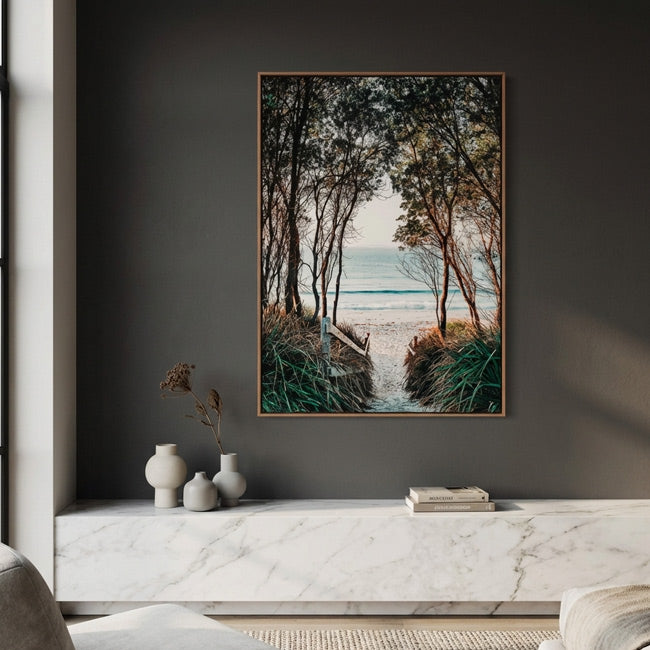
Black and white imagery is particularly adaptable because it can connect with different interior styles without requiring a room to adopt a literal coastal theme. A photograph of a recognisable beach can sit alongside timber furniture, linen upholstery, neutral walls or contemporary architecture. Its subject provides the connection to the coast, while its tonal range allows the artwork to work with the materials already present.
Scale and framing still matter. A broad landscape may benefit from a larger format that gives its horizon room to breathe, while a more concentrated composition may work as part of a group of photographs. The important decision is to give the image enough space for its distinctive qualities to remain visible. If the location is the reason the photograph matters, avoid surrounding it with so many competing decorations that its identity becomes difficult to appreciate.
For those drawn to this approach, the Black & White Coastal Wall Art collection brings together original photographs of beaches, ocean landscapes, surfers, palm trees and coastal architecture. Exploring the range of subjects makes it possible to choose a photograph not only for its appearance but also for the kind of place and atmosphere it represents.
The Lasting Value of a Photograph That Knows Where It Belongs
The most memorable coastal photographs do more than show us what a beach looks like. They give the landscape a particular identity through the details that could not be exchanged quite so easily with another location. A familiar shoreline, a recognisable structure or a solitary figure can turn a broad subject into a specific experience. When the image also carries personal associations, its meaning extends beyond the photograph itself.
That is the enduring appeal of black and white beach photography. Its strength is not simply that monochrome suits modern interiors or that black and white prints remain easy to style. It is that the medium can reveal the character of a place without relying on the familiar colours through which we usually recognise the coast. Light, texture, distance and human presence become ways of understanding the landscape rather than merely decorating it.
A home can contain artwork chosen for many reasons: its composition, its scale, its relationship with furniture or its contribution to a room's atmosphere. But a photograph of a real place offers something additional. It can hold the memory of somewhere visited, express a connection to a coastline or preserve the feeling of standing before a landscape that seemed larger than everyday life. That is what allows a beach photograph to remain meaningful after decorating trends have changed.
A generic image can suggest the idea of the sea. A photograph with a strong sense of place can remind us why a particular stretch of coast matters. And when that distinction is captured in a thoughtfully composed monochrome print, the result is artwork that can belong to a room for reasons far deeper than its colour scheme.


Leave a comment
This site is protected by hCaptcha and the hCaptcha Privacy Policy and Terms of Service apply.