

Botanical Wall Art: How to Bring Nature Into a Modern Interior
Modern interiors have become very good at simplicity.
Clean lines, restrained colours, natural timber, stone, linen and carefully chosen furniture can create rooms that feel calm and sophisticated. But there is a point where simplicity can become something else. A room can be beautifully designed and still feel slightly empty, as though it has everything it needs except a sense of life.
That is where botanical wall art can make an unexpected difference.
Flowers, leaves, branches and plants have been part of visual art for centuries, long before anyone described them as an interior design trend. The Metropolitan Museum of Art notes that botanical imagery has appeared throughout the history of Western painting, serving everything from decorative and symbolic purposes to detailed studies of the natural world.
Today, the way we use that imagery has changed. Instead of a traditional botanical painting hanging in a formal study, a close-up photograph of a flower might sit above a contemporary sofa, an Australian native plant might become the focal point of a minimalist hallway, or a collection of botanical prints might bring softness to an otherwise architectural room.
The appeal is not really about following a floral trend.
It is about bringing something organic into a space that may otherwise be dominated by straight lines, hard surfaces and manufactured materials.
Botanical Art Has Always Been About More Than Decoration
There is an interesting history behind the way we look at plants as art.
The tradition of botanical illustration is closely connected with careful observation. The Royal Horticultural Society describes botanical illustration as a genre concerned with faithfully representing the form, colour, character and detail of a plant, while also maintaining visual appeal.
That combination of observation and beauty is part of what makes botanical subjects so enduring.
The artist has to really look at the plant — its structure, the way its petals overlap, the veins in its leaves, the irregularities in its shape. The resulting image isn't simply a picture of a flower. It is an interpretation of something that already exists in nature.
The RHS has been collecting botanical artwork for centuries and today holds more than 30,000 botanical paintings dating back to the 1630s, alongside historic photographic material.
So when we talk about botanical artwork in a modern home, we're not talking about a passing decorating idea. We're continuing a much older relationship between plants, observation, art and the spaces in which people live.
What has changed is the language.
Photography has given artists another way to look at the natural world.
From Botanical Illustration to Botanical Photography
Traditional botanical illustration often asks the artist to document a plant with extraordinary precision. Contemporary botanical photography can approach the same subject very differently.
Instead of showing the entire plant, a photograph might isolate a single flower. It might exaggerate scale, focus on texture, use shallow depth of field or reduce the plant to colour and form.
That difference matters when you're choosing artwork for a modern interior.
A highly detailed traditional illustration can bring an elegant, classical quality to a room. A close-up photographic flower print, on the other hand, can feel much more contemporary. It can behave almost like an abstract artwork while still being recognisably connected to nature.
This is one of the reasons we enjoy working with botanical photography at Oblong Shop.
Our Botanicals & Florals collection isn't limited to one interpretation of flowers. It moves between delicate blooms, Australian native plants, foliage, palms, cacti and more, allowing botanical imagery to work across very different interior styles.
Explore the Oblong Shop Botanicals & Florals Collection
The result is a collection that can feel natural in a minimalist apartment just as easily as it can in a warmer, more traditional home.
Why Botanical Wall Art Works So Well in Modern Interiors
The secret isn't necessarily the flower itself.
It is the contrast.
Modern interiors often rely on architectural forms: rectangular furniture, straight shelving, clean cabinetry, large windows and defined spaces. Botanical imagery introduces shapes that behave differently. Leaves curve. Petals overlap. Branches move in unexpected directions.
That contrast can make a room feel more balanced.
Imagine a simple living room with a neutral sofa, timber coffee table and pale walls. There may be nothing wrong with the room at all, but a large blank wall can make the whole space feel unfinished.
A piece of floral wall art can change that without requiring the rest of the room to change.
The artwork introduces organic shapes and colour while leaving the architecture intact.
This is particularly effective when the botanical image has enough visual simplicity to complement the room rather than compete with it.
A good piece doesn't need to turn your home into a garden.
It simply needs to remind the room that nature exists beyond its walls.
Choosing the Right Botanical Artwork for Your Space
One of the easiest mistakes to make when buying botanical art prints is choosing the subject first and thinking about the room afterwards.
Instead, start with the room.
Look at the colours already present. Consider the furniture, flooring, natural light and the amount of visual detail around the wall you're decorating.
If your interior is predominantly neutral, a botanical photograph with stronger greens, yellows or pinks can introduce colour without requiring a complete redesign.
If the room already contains plenty of colour, a quieter floral photograph may work better.
A small flower artwork can disappear above a large sofa or console, while a large botanical composition can give a smaller room too much visual weight. In larger spaces, oversized artwork or a carefully arranged group of prints can create a stronger relationship with the furniture beneath it.
This is where framing also becomes important.
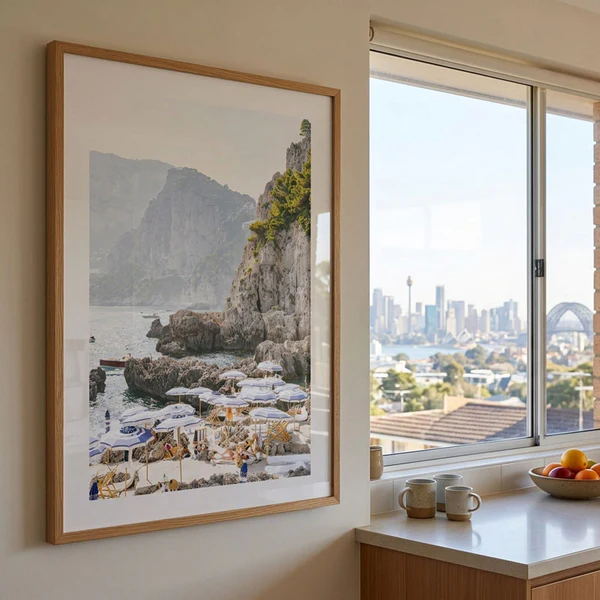
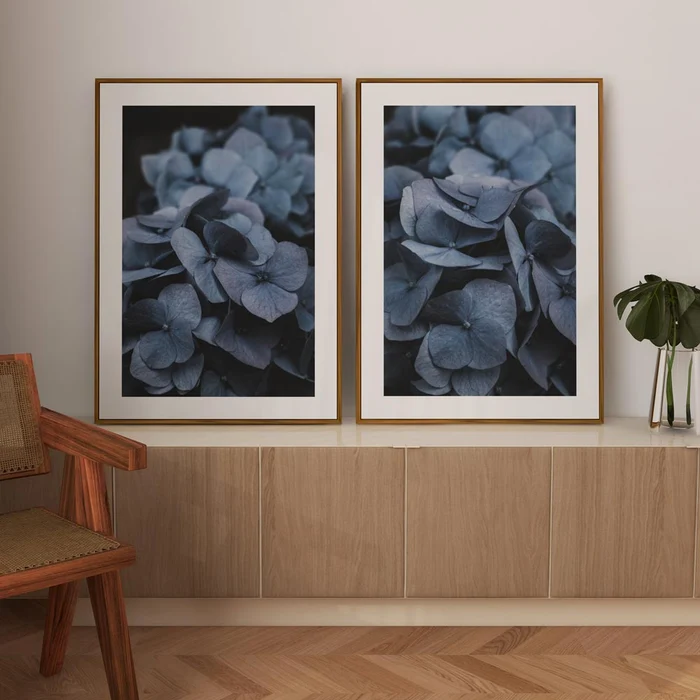
A simple black frame can give botanical photography a crisp, contemporary appearance. Natural timber can make the artwork feel warmer and connect it with wood, linen and other natural materials already present in the room.
The photograph may be the starting point, but the finished piece is the combination of image, scale, frame and surrounding space.
Australian Botanicals Bring a Different Character
There is another reason botanical wall art can be particularly interesting in an Australian interior: Australian plants have a visual character of their own.
Eucalyptus leaves, gum nuts, wattle, banksia and proteas don't necessarily resemble the traditional European flowers that have dominated botanical art for centuries. Their shapes, textures and colours can give a room something more distinctive.
That character is reflected throughout the Oblong collection.
Our floral collection includes Wattle Green and Gold, Yellow Banksia, Australian Pink Eucalyptus, Australian Gum Nuts, Queen Protea, Pink Queen Protea and other botanical subjects alongside hydrangeas, palms and flowers.
Browse Australian botanical and floral artwork
For someone decorating a contemporary Australian home, these images can feel particularly natural because they aren't trying to imitate another landscape or gardening tradition.
They belong to the visual language of the place.
And yet, they don't have to stay in Australia.
A beautifully photographed banksia or eucalyptus can work just as effectively in a New York apartment, a California home or a hotel anywhere in the world. Once the photograph becomes artwork, its relationship with the room is no longer limited by geography.
When a Flower Becomes Almost Abstract
One of my favourite things about floral artwork is how easily a flower can stop looking like a flower.
Move close enough and the familiar subject begins to disappear.
A petal becomes a curve. A cluster of leaves becomes a pattern. Texture becomes more important than recognition. Colour becomes the dominant feature.
This is where botanical photography starts to overlap with modern art.
You don't necessarily need to love flowers to appreciate a well-composed floral photograph.
You can respond to the shape, colour, negative space or composition without thinking about the plant itself.
That makes contemporary botanical artwork particularly versatile. It can satisfy someone looking for flower wall decor while still fitting into an interior that otherwise has very little traditional or decorative styling.
The subject may be organic, but the finished artwork can feel remarkably modern.
Botanical Wall Art for a Calm Living Room
The living room is probably the easiest place to see this principle at work.
A large blank wall behind a sofa naturally creates a visual focal point. You could fill it with shelving, mirrors or a gallery wall, but sometimes a single botanical piece creates a stronger result because it gives the eye one place to settle.
A large floral photograph works especially well when the rest of the room is restrained.
Think of a neutral sofa, timber furniture, soft textiles and natural light. A botanical image introduces another layer without changing the overall character of the space.
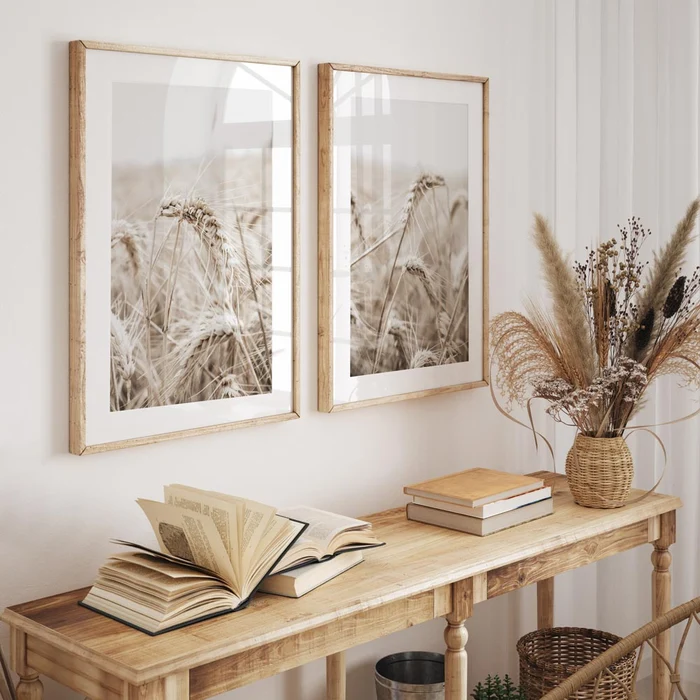
For a more collected look, two or three related framed floral wall art pieces can work together. They don't necessarily have to show the same flower. What matters is that they share something — similar tones, composition, framing or photographic style.
The goal isn't to make the wall look like a catalogue of flowers.
It is to create a visual rhythm that feels intentional.
Botanical Artwork Doesn't Have to Look Traditional
There is still a perception that flower artwork belongs in a particular kind of home: ornate furniture, traditional wallpaper, heavy frames and formal rooms.
It doesn't.
In fact, some of the most successful botanical interiors are built around contrast.
A highly contemporary room can become more interesting when paired with an organic subject. A minimalist interior can gain warmth from a detailed flower photograph. An industrial space can soften considerably when botanical imagery is introduced against concrete, metal or darker materials.
This is why I think botanical wall art is more versatile than the term sometimes suggests.
The artwork doesn't dictate the style of the room.
The way it is photographed, printed, framed and positioned determines how it participates in that style.
A botanical photograph with lots of negative space can feel minimalist. A saturated flower close-up can feel dramatic. A muted Australian landscape of foliage can feel quiet and natural.
A Collection Built From Real Plants, Places and Observation
At Oblong Shop, our approach to botanical artwork starts with photography rather than generic decorative graphics.
The images in the Botanicals & Florals collection are part of our wider photography-based approach to wall art, with original photography captured by photographer Seus Ku. The collection currently spans a wide range of subjects, from hydrangeas and proteas to Australian eucalyptus, wattle, gum nuts, palms and other botanical forms.
That distinction matters because a photograph carries the imperfections and details of the real subject.
A leaf isn't perfectly symmetrical.
A flower isn't manufactured to fit a template.
Light falls differently across every petal.
Those small variations are often what make the finished artwork feel alive.
And they are also what allow a simple flower print to become something more than decoration.
It becomes a record of something that actually existed in front of the camera.
Bringing Nature Into a Modern Home Doesn't Mean Filling It With Plants
There is an understandable temptation to think that connecting a home with nature means adding more houseplants.
Plants are wonderful, of course, but they aren't the only way to introduce natural character into an interior.
Sometimes the room doesn't need another object.
It needs an image.
A piece of botanical wall art can provide that connection without requiring maintenance, watering, sunlight or additional furniture. It can occupy the same visual space as a large mirror or painting while bringing a very different quality into the room.
And unlike a living plant, artwork stays exactly where you put it.
The flower doesn't wilt.
The leaves don't change.
The photograph preserves a particular moment and allows that moment to become part of the room indefinitely.
That may be one reason botanical imagery has remained so relevant across different forms of art. The RHS's own collections demonstrate how plant imagery has evolved from highly detailed botanical illustration into contemporary approaches including photography, while maintaining the same fascination with the natural world.
The Modern Botanical Wall
Perhaps the most interesting thing about botanical art is that it doesn't really belong to any one era.
Flowers have appeared in paintings for centuries. Botanical illustrations became important records of plants and scientific knowledge. Floral still lifes became a major artistic tradition in Europe, with painters using flowers for both their beauty and symbolism.
Today, we can look at those traditions through a completely different lens.
A botanical photograph can be enlarged into a statement piece. A single flower can become almost abstract. Australian native plants can be photographed with the same care once reserved for exotic specimens. And a simple framed print can bring all of that history into a very contemporary room.
That is what makes botanical wall art so enduring.
It doesn't require your home to look traditional.
It doesn't require you to follow a particular decorating trend.
And it doesn't even require you to be particularly interested in gardening.
You simply need a wall that could use a little more life.
Finding the Right Botanical Artwork
The best botanical artwork is ultimately the piece that feels right in your particular space.
Maybe that means the quiet green of eucalyptus against a pale wall. Maybe it is the sculptural shape of a protea. Perhaps it is the soft complexity of a hydrangea, the architectural form of a palm, or a more colourful floral composition that becomes the room's focal point.
The important thing is not to choose a piece simply because it contains a flower.
Choose it because you like what happens when you look at it.
Does it bring colour into the room? Does it soften the furniture? Does it create contrast with the architecture? Does it remind you of somewhere? Does it make an otherwise empty wall feel intentional?
Those questions are ultimately more useful than asking whether something is currently fashionable.
Because the most successful botanical wall art isn't artwork that follows a trend.
It is artwork that becomes part of the room.
And when a photograph of a flower, leaf or Australian native plant can do that — quietly adding colour, organic form and a connection to the natural world — it becomes something more lasting than simple wall decor.
It becomes part of how the room feels.

Leave a comment
This site is protected by hCaptcha and the hCaptcha Privacy Policy and Terms of Service apply.