

Hydrangea Wall Art: Decorating With One of Nature's Most Beautiful Flowers
Some flowers are difficult to ignore.
Hydrangeas are one of them. Their blooms don't arrive as a single delicate shape but as generous clusters of hundreds of small flowers, creating rounded forms that can look almost architectural when photographed up close. Depending on the variety and growing conditions, those clusters can move through shades of blue, pink, white, purple and green, sometimes changing character as they mature.
That combination of scale, texture and colour is part of what makes hydrangeas so compelling in a garden. But it is also what makes them unusually well suited to wall art.
A hydrangea photograph can bring the feeling of a garden into a room without making the interior feel overly floral. It can introduce colour without requiring a colourful room, and its intricate structure can provide visual detail while still feeling calm.
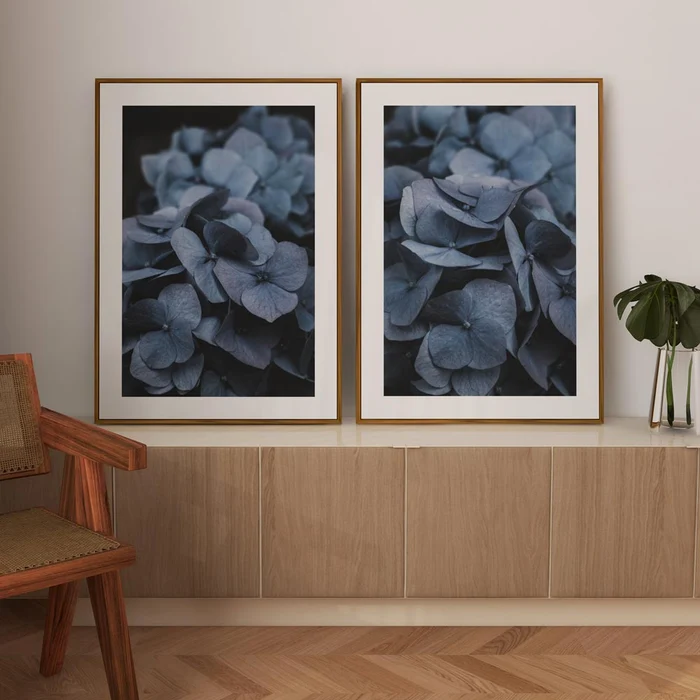
At Oblong Shop, we have always been interested in photographing flowers not simply as subjects, but as compositions. Hydrangea I is one example of that approach: a close photographic study of hydrangea flowers that allows the natural structure, colour and texture of the bloom to become the artwork itself.
Why Hydrangeas Make Such Interesting Subjects for Art
There is a reason hydrangeas have appeared repeatedly in gardens, photography, painting and decorative arts.
The plant has an unusual visual structure. The large flower heads are made up of many individual flowers, creating a surface that can appear almost cloud-like from a distance and incredibly intricate when viewed closely.
The Royal Horticultural Society describes hydrangeas as having showy but delicate, long-lasting flowers in shades including pink, white and blue, with many varieties also offering attractive foliage and autumn colour.
That range gives photographers plenty to work with.
A hydrangea can be photographed as a recognisable garden flower, but it can also be reduced to colour, shape and texture. Move closer and the familiar flower starts to become something else: overlapping petals, curved edges, subtle shadows and hundreds of small details.
At that point, you don't necessarily need to be interested in gardening to appreciate the image.
It starts behaving like modern art.
The Beauty Is in the Details
Look closely at a hydrangea and it becomes clear why a photograph can capture something that a quick glance at the flower might miss.
The individual blooms overlap one another. Some petals sit in light while others fall into shadow. Small changes in colour move across the flower head, and the overall form is never perfectly uniform.
These imperfections are part of its character.
The Smithsonian's National Museum of Natural History notes that hydrangea flower heads contain different types of flowers and that their colours can vary in relation to chemistry and growing conditions. The institution also traces the plant's cultivation history and its long-standing presence in Asian horticulture.
That variation is particularly interesting when translated into photography.
Instead of seeing a flower as one flat colour, you begin to notice all the colours within it.
Instead of seeing a simple round bloom, you start seeing hundreds of individual forms.
And instead of looking at a plant from several feet away, the photograph allows you to become immersed in it.
That is what makes a close-up hydrangea wall art piece so different from simply putting a picture of a flower on the wall.
Hydrangea I: Turning a Flower Into a Composition
Hydrangea I was photographed by Seus Ku and is part of Oblong Shop's botanical and floral photography collection. The image looks closely at the hydrangea itself, allowing the flowers and foliage to fill the frame rather than treating the plant as a small element within a larger landscape.
That approach gives the photograph a certain versatility.
It doesn't have to live in a traditional room filled with floral patterns. In fact, the closer, more graphic quality makes it particularly well suited to contemporary interiors.
Against a plain wall, the photograph becomes a field of organic shapes and subtle colour. Around timber, linen, stone or neutral furniture, the natural subject adds softness without introducing another competing design element.
This is one of the reasons we like floral photography for interiors.
The artwork can acknowledge the natural world without asking the rest of the room to become themed around it.
How to Use Hydrangea Wall Art in a Modern Home
The easiest way to style a floral photograph is often to start with what is already in the room.
If your furniture and walls are neutral, hydrangea artwork can introduce colour without forcing you to redesign the space. Soft blues can complement cool neutrals and whites, while pinks and warmer tones can work beautifully with timber, beige, cream and other natural colours.
The same principle works in reverse.
If a room already contains strong colours, a more restrained floral photograph can help soften the overall palette rather than adding another competing colour.
The scale of the artwork matters just as much.
A small flower print can work beautifully on a bedside table, in a hallway or as part of a collection of smaller pieces. But hydrangeas also lend themselves to larger artwork because their clustered forms remain visually interesting when enlarged.
Above a sofa, console or bed, a larger piece of floral wall art can become the focal point of the room without feeling as heavy as some geometric or highly abstract artwork.
The flower itself provides enough detail to hold attention.
One Large Floral Artwork or Several Smaller Pieces?
There is no single correct way to decorate with botanical artwork.
A large hydrangea photograph can be particularly effective when the wall needs one strong focal point. This works well above furniture where the artwork can establish a clear relationship with the object beneath it.
For example, a wide sofa with a relatively simple wall behind it can benefit from one substantial piece rather than several small artworks that may make the arrangement feel fragmented.
Smaller pieces offer a different possibility.
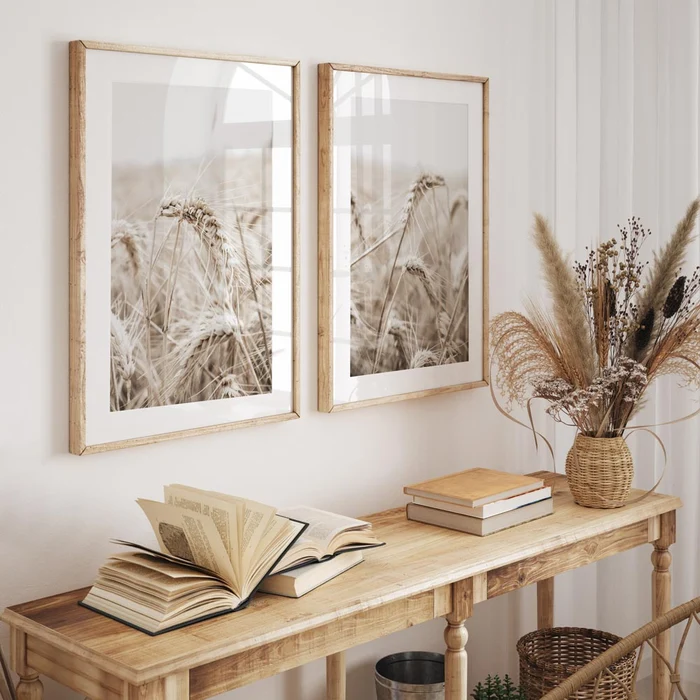
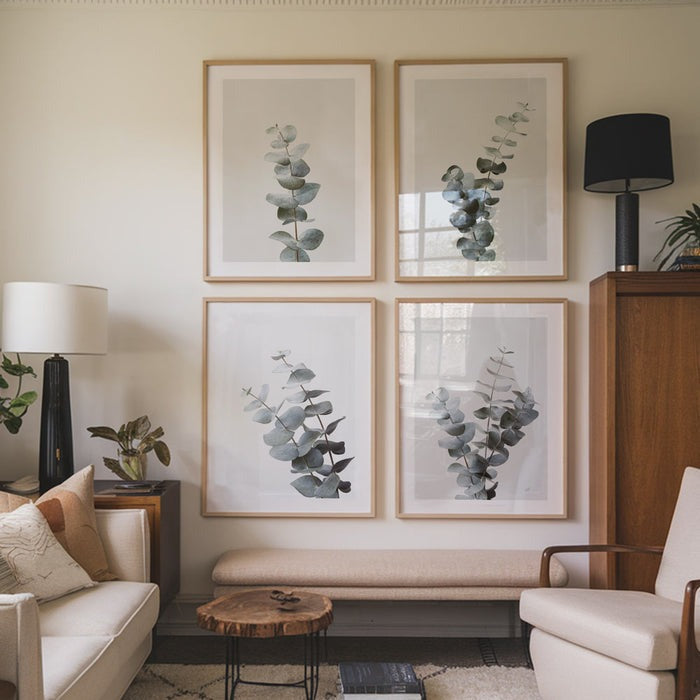
A pair of floral photographs can create symmetry. Several related botanical images can form a gallery wall. And a hydrangea can be paired with other flowers or foliage where the colours and photographic style have enough in common to make the collection feel intentional.
The important thing is not that every image shows the same flower.
It is that the artwork feels as though it belongs to the same visual conversation.
Framed Hydrangea Wall Art Has a Different Character
The way a floral photograph is presented can change how it feels in the room.
A print without a frame has a lighter, more informal quality and can work particularly well when you're creating a gallery wall or using a custom frame that matches your existing interior.
A framed hydrangea photograph, on the other hand, feels more finished from the moment it reaches the wall.
At Oblong Shop, Hydrangea I can be ordered in several presentation options, including black, natural, white, gold and silver frames, as well as an unframed print. The frames use sustainably sourced timber and optical-grade perspex, while the prints are produced with museum-grade inks on premium matte paper.
That range makes it easier to adapt the same artwork to very different interiors.
A natural frame can emphasise the organic character of the flower and work beautifully with timber furniture. Black can give the image a sharper, more contemporary edge. White can make the artwork feel lighter against a pale interior.
The photograph stays the same.
The atmosphere changes with the presentation.
Hydrangeas and the Quiet Luxury of Natural Detail
There is a reason botanical imagery continues to work so well in interiors that favour restrained design.
Natural subjects contain a tremendous amount of detail without necessarily feeling visually aggressive.
A flower has complexity, but it doesn't look manufactured.
Leaves have patterns, but those patterns are irregular.
Petals have colour, but the colour changes gradually rather than appearing as a hard block.
That makes floral artwork particularly useful in rooms where the furniture and architecture are intentionally simple.
Instead of adding another geometric object, you introduce something organic.
Instead of another hard surface, you introduce texture.
Instead of another piece of furniture, you introduce an image that suggests the natural world.
The result can feel luxurious without being overly formal.
A Flower With a Long History in Art
Hydrangeas may feel contemporary when photographed as large-scale wall artwork, but the relationship between flowers and art is anything but new.
Botanical subjects have been carefully documented and artistically represented for centuries. The Royal Horticultural Society, for example, has maintained an extensive tradition of botanical artwork dating back hundreds of years, including paintings that record plants with remarkable botanical detail.
Hydrangeas themselves have also appeared in decorative arts and cultural objects for generations. The Smithsonian's historical research into the plant points to hydrangea imagery in objects dating back to the eighteenth and early twentieth centuries, illustrating how the flower has moved beyond horticulture into visual culture.
What has changed is how we interpret the subject.
Today, we can photograph a flower at a scale that would have been impossible for most earlier artists to reproduce. We can isolate a single bloom, capture its texture in extraordinary detail and print it at a size where the viewer almost feels as though they are standing inside the flower itself.
The technology is modern.
The fascination is not.
Why Floral Artwork Doesn't Have to Feel Feminine or Traditional
One misconception about flower artwork is that it automatically gives a room a soft or traditionally feminine character.
That really depends on the photograph.
A tightly composed botanical photograph with strong structure and controlled colour can feel just as contemporary as an abstract print. The frame, scale and surrounding furniture can push the artwork in completely different directions.
Hydrangeas are particularly versatile because their natural forms can be both delicate and substantial.
A close-up photograph can feel almost sculptural.
A muted image can become quietly atmospheric.
A highly detailed image can create visual depth on an otherwise plain wall.
And a larger floral composition can become a statement piece rather than a decorative accessory.
This is why flower wall art doesn't need to be limited to bedrooms or traditionally decorated spaces. It can work in living rooms, dining areas, entryways, offices and commercial interiors just as naturally.
Hydrangea Art for Bedrooms, Living Rooms and Beyond
Bedrooms are an obvious place for botanical imagery because flowers naturally lend themselves to quieter, more restful compositions.
A framed hydrangea print above a bedside table or on the wall opposite the bed can introduce colour and detail without making the room feel busy.
In a living room, the same artwork can play a stronger role. A larger piece above the sofa can establish the palette for cushions, throws and other decorative details.
In a dining room, floral artwork can soften the harder surfaces that often surround the dining table.
And in a hallway, a botanical photograph can transform an otherwise transitional space into something worth stopping to look at.
That flexibility is one of the reasons botanical imagery has remained so useful in interior design.
It doesn't demand a particular room.
It adapts to the one you already have.
Choosing Between Flowers, Foliage and Botanical Photography
Hydrangeas are only one possibility.
If you're drawn to the natural character of botanical artwork but aren't sure which direction to take, it can help to think about what you want the artwork to contribute.
Flowers generally bring more colour and softness.
Foliage can feel quieter and more architectural.
Australian native plants can introduce distinctive shapes and textures.
Close-up botanical photography can create a more contemporary or abstract effect.
At Oblong Shop, these different approaches come together in the Botanicals & Florals collection, which includes hydrangeas alongside Australian eucalyptus, wattle, banksia, protea, palms and other floral and botanical subjects. The collection is built around original photography by Seus Ku rather than generic decorative graphics.
Explore the Botanicals & Florals Collection
That makes it possible to stay within the same general botanical style while choosing artwork that suits the colours and character of your own space.
The Lasting Appeal of the Hydrangea
Perhaps the reason hydrangeas work so well as artwork is that they sit somewhere between familiarity and discovery.
Most people recognise a hydrangea immediately.
But when you photograph one closely, there is still plenty left to discover.
The layers of petals, the subtle shifts in colour, the shadows between individual flowers and the sheer density of the bloom give the subject an almost abstract quality.
That means a hydrangea photograph can be appreciated on two levels.
You can see the flower.
Or you can simply see the composition.
And that is what makes Hydrangea I more than a picture of a garden flower. It is a study of colour, texture, structure and natural form — translated into a piece of wall artwork designed to live inside a home.
For someone looking for a way to bring nature into a modern interior, that distinction can make all the difference.
You don't need a room full of plants.
You don't need floral wallpaper.
You don't even need to follow a particular decorating style.
Sometimes one carefully chosen photograph is enough to bring the natural world into the room.
And when that photograph is a hydrangea, there is rather a lot of beauty packed into one flower.

Leave a comment
This site is protected by hCaptcha and the hCaptcha Privacy Policy and Terms of Service apply.