

Why We're Naturally Drawn to Flowers in Art and Interior Design
Walk into almost any culture, anywhere in the world, and you'll find flowers playing a meaningful role in human life.
They appear in celebrations, weddings, places of worship, gardens, paintings, and homes. We gift them during moments of joy and place them beside us during moments of reflection. Even in today's increasingly digital world, people continue to surround themselves with floral imagery in countless forms.
This raises an interesting question.
Why do flowers matter so much to us?
After all, from a purely practical perspective, flowers serve no essential purpose inside a home. They don't provide shelter, food, or function. Yet people continue to seek them out, display them, and incorporate them into their living spaces through fresh arrangements, gardens, and increasingly through floral wall art.
The answer lies deeper than decoration.
Our attraction to flowers is rooted in thousands of years of human psychology, our relationship with nature, and our instinctive response to signs of life, growth, and abundance.
Flowers Have Always Signalled Something Positive
Long before modern cities existed, flowers served as important indicators within natural environments.
A landscape in bloom often signalled the arrival of favourable conditions. Flowers suggested access to water, healthy ecosystems, fertile land, and the promise of future growth. For early humans, these environmental cues were valuable because they indicated places where life could flourish.
While most of us no longer depend on these signals for survival, our brains still respond to them.
Researchers studying environmental psychology have repeatedly found that people tend to react positively to natural forms and organic patterns. Flowers, with their colour, symmetry, and connection to seasonal renewal, continue to evoke feelings of optimism and vitality.
This helps explain why floral imagery often feels uplifting even when we don't consciously think about it. The response isn't simply aesthetic. It's deeply embedded in the way humans interpret the natural world.
Why Flowers Make Spaces Feel More Welcoming
There is a reason hotels, luxury resorts, and thoughtfully designed homes frequently incorporate floral elements.
Flowers introduce something that many modern environments lack: softness.
Contemporary architecture often relies on straight lines, hard surfaces, and structured forms. While these elements can create elegance and order, they can also feel cold if not balanced by something more organic.
Flowers provide that balance.
Their curves, textures, and natural imperfections introduce warmth into a space. They soften visual environments and make rooms feel more inviting.
This is one reason flower wall art remains so effective in interior design. It introduces the emotional benefits associated with nature without requiring constant maintenance or seasonal replacement.
Unlike temporary floral arrangements, artwork allows those qualities to become a permanent part of a room's atmosphere.
The Connection Between Flowers and Wellbeing
The growing popularity of biophilic design has highlighted something many people already intuitively understand: humans feel better when they maintain a connection to nature.
Natural environments have been shown to support relaxation, improve mood, and reduce feelings of stress. While indoor plants are often discussed in this context, artwork can play a similar role by creating visual connections to the natural world.
This is where floral imagery becomes particularly powerful.
A thoughtfully chosen piece doesn't simply add colour to a wall. It acts as a reminder of growth, renewal, and beauty. These associations can subtly influence how a space feels over time.
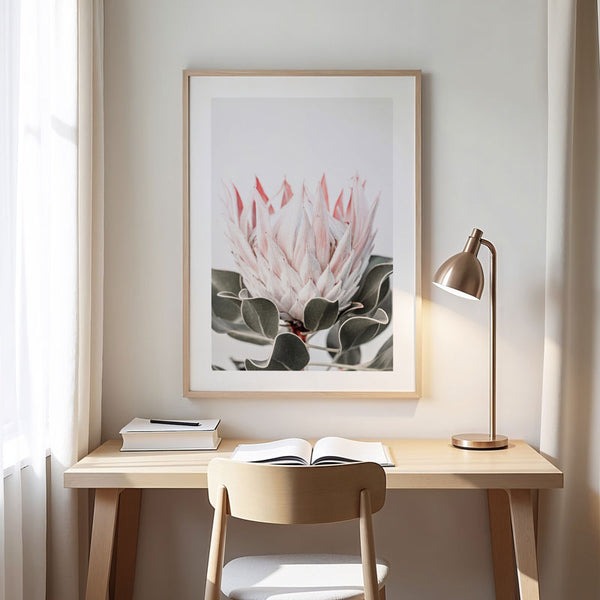
Consider Queen Protea Flower Art Print. Beyond its striking appearance, the image celebrates one of nature's most remarkable blooms. Its sculptural form creates visual interest while maintaining a sense of calm and elegance. The result is artwork that feels both contemporary and timeless.
Similarly, Yellow Banksia Art Print draws inspiration from Australia's unique native flora. The artwork introduces natural texture and character while maintaining the understated sophistication that many modern interiors seek.
In both cases, the artwork does more than decorate. It contributes to the emotional experience of the room.
Why Floral Art Has Survived Every Design Trend
Interior design trends are constantly evolving.
Colours change. Materials change. Furniture styles change.
Yet floral imagery has remained relevant for centuries.
The reason is simple.
Flowers are not tied to a particular era or design movement. They exist outside trends because they are connected to something far more enduring: nature itself.
Throughout history, flowers have appeared in classical paintings, traditional textiles, botanical illustrations, and contemporary photography. Each generation interprets them differently, yet the underlying appeal remains remarkably consistent.
This is why botanical prints wall art continues to work equally well in modern apartments, heritage homes, minimalist interiors, and contemporary commercial spaces.
Unlike many decorative trends that eventually feel dated, botanical subjects retain their relevance because they are rooted in universal human experiences.
More Than Decoration: Flowers as Storytelling
The most memorable interiors are rarely defined by furniture alone.
They are shaped by the stories they tell.
Artwork often becomes one of the strongest storytelling elements within a home because it reflects personal values, interests, and emotional connections.
Flowers are uniquely effective storytellers because they carry meaning without requiring explanation. They represent growth, resilience, beauty, change, and renewal. These themes resonate across cultures and generations.
When someone chooses a floral artwork, they are often responding to more than colour or composition. They are responding to the emotions and ideas the image represents.
This is one reason the Florals Collection feels so timeless. Rather than simply showcasing flowers, the collection celebrates the relationship between nature and human experience. Each piece offers a different interpretation of that connection, allowing homeowners to choose artwork that reflects their own personality and aesthetic.
Why Flowers Continue to Belong in Modern Homes
As modern life becomes increasingly fast-paced and technology-driven, the desire to reconnect with nature continues to grow.
People are seeking homes that feel calmer, warmer, and more restorative. They want environments that support wellbeing rather than simply impress visitors.
Floral imagery helps achieve exactly that.
Whether displayed as framed floral wall art, incorporated into a gallery arrangement, or featured as a statement piece, botanical subjects introduce a sense of life that few other decorative elements can match.
The enduring popularity of wall art inspired by flowers is not an accident. It reflects something deeply human—a natural attraction to beauty, growth, and the living world around us.
The best interiors are not simply designed. They are felt.
And perhaps that is why flowers continue to inspire artists, homeowners, and designers generation after generation. A carefully chosen piece of canvas art does more than fill a blank wall. It brings nature indoors, creates emotional connection, and reminds us of something we instinctively understand: life feels better when we remain connected to the natural world.

Leave a comment
This site is protected by hCaptcha and the hCaptcha Privacy Policy and Terms of Service apply.